
Grounding, Glucose and Erythrocyte Metabolism During Exercise

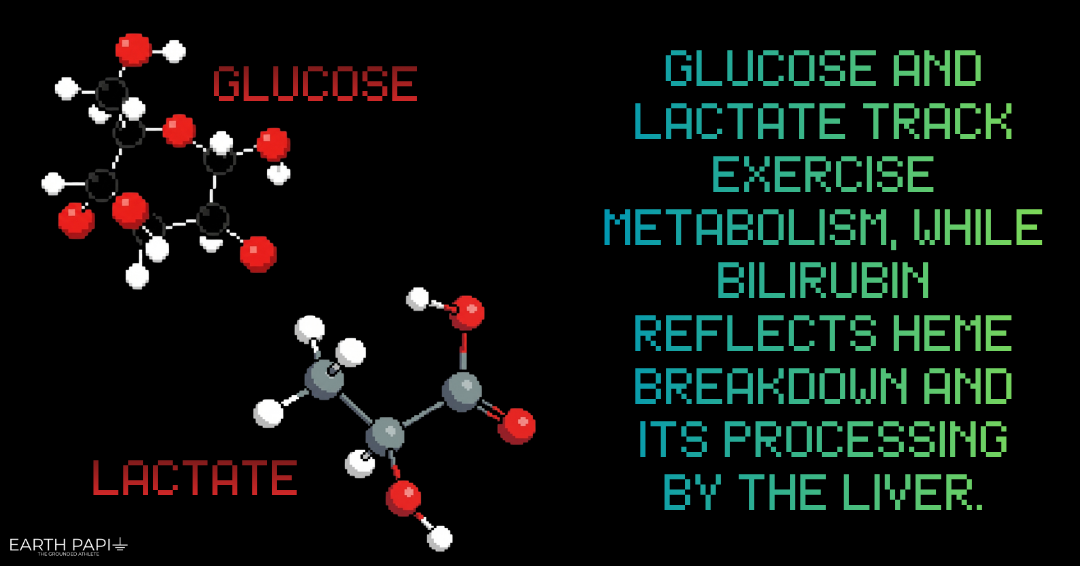
Glucose and lactate reflect how fuel is produced and used during exercise. Bilirubin is formed during heme breakdown and is processed by the liver. Together, these blood markers provide a limited view of energy metabolism and red blood cell turnover.
In 2016, Sokal and colleagues examined whether grounding altered these markers during exercise and recovery. Their double blind crossover study included 42 participants separated into groups according to maximal oxygen uptake. Each participant completed two 30 minute cycling sessions: one while grounded and one while electrically insulated. Reversing the conditions allowed each participant to serve as their own comparison.

During grounded exercise, glucose increased after 15 minutes, decreased by 30 minutes and rose again during the 40 minute recovery period. Without grounding, glucose initially decreased and then gradually increased. Bilirubin also responded differently between the grounded and insulated conditions. The patterns varied with body mass.
Participants with lower body mass also consumed more oxygen at the end of exercise while insulated than while grounded. This means the same exercise was associated with different metabolic and oxygen consumption responses depending on electrical contact with the Earth. It does not independently prove greater muscular efficiency because muscle glucose uptake, insulin, respiratory exchange ratio and ATP production were not directly measured.

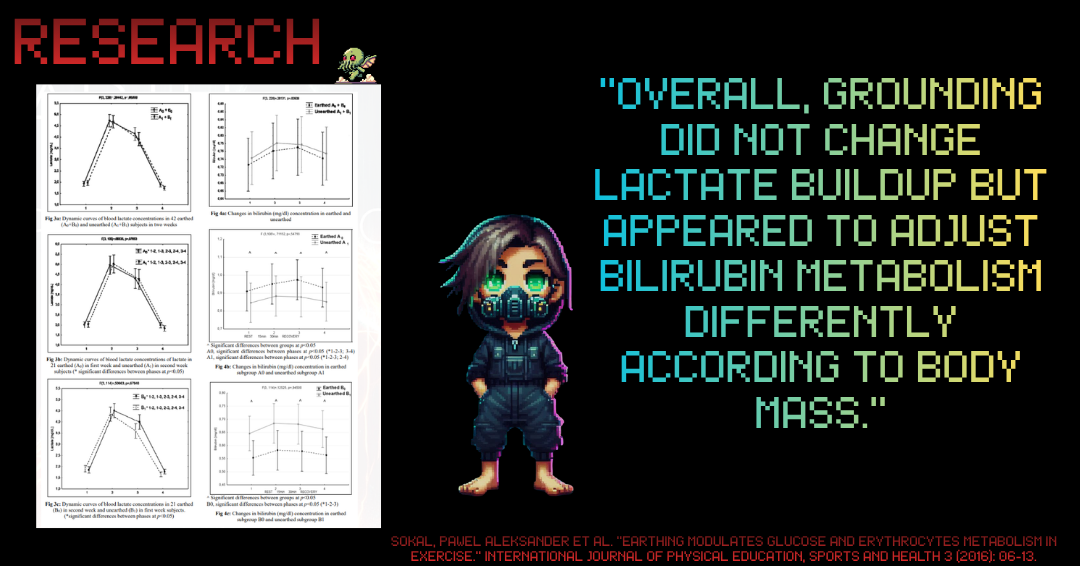
The most precise conclusion is that grounding altered the time course of circulating glucose and bilirubin during exercise and recovery. The responses were related to body mass and were accompanied by a difference in oxygen consumption within the lower mass group. The authors interpreted these findings as evidence that grounding modulates glucose availability and erythrocyte associated metabolism during exercise. (Sokal et al., 2016)
As always, if you’re interested in learning more about grounding, check out Earth & Water.


References:
Andersen LW, Mackenhauer J, Roberts JC, Berg KM, Cocchi MN, Donnino MW. Etiology and therapeutic approach to elevated lactate levels. Mayo Clin Proc. 2013 Oct;88(10):1127-40. doi: 10.1016/j.mayocp.2013.06.012. PMID: 24079682; PMCID: PMC3975915.
Witek K, Ścisłowska J, Turowski D, Lerczak K, Lewandowska-Pachecka S, Pokrywka A. Total bilirubin in athletes, determination of reference range. Biol Sport. 2017 Mar;34(1):45-48. doi: 10.5114/biolsport.2017.63732. Epub 2016 Dec 1. PMID: 28416897; PMCID: PMC5377560.
Bergh U, Sjödin B, Forsberg A, Svedenhag J. The relationship between body mass and oxygen uptake during running in humans. Med Sci Sports Exerc. 1991 Feb;23(2):205-11. PMID: 2017016.
Porter RK, Brand MD. Cellular oxygen consumption depends on body mass. Am J Physiol. 1995 Jul;269(1 Pt 2):R226-8. doi: 10.1152/ajpregu.1995.269.1.R226. PMID: 7631898.
Benedik PS, Hamlin SK. The physiologic role of erythrocytes in oxygen delivery and implications for blood storage. Crit Care Nurs Clin North Am. 2014 Sep;26(3):325-35. doi: 10.1016/j.ccell.2014.04.002. PMID: 25169686.
Jensen FB. The dual roles of red blood cells in tissue oxygen delivery: oxygen carriers and regulators of local blood flow. J Exp Biol. 2009 Nov;212(Pt 21):3387-93. doi: 10.1242/jeb.023697. PMID: 19837879.
Louajri A, Harraga S, Toubin G, Kantelip JP. Red blood cell metabolism and hemoglobin oxygen affinity. Effect of vinburnine on normobaric hypoxic rats. Biol Pharm Bull. 1999 Aug;22(8):773-4. doi: 10.1248/bpb.22.773. PMID: 10480311.
MacDonald R. Red cell 2,3-diphosphoglycerate and oxygen affinity. Anaesthesia. 1977 Jun;32(6):544-53. doi: 10.1111/j.1365-2044.1977.tb10002.x. PMID: 327846.
Chevalier G. Changes in pulse rate, respiratory rate, blood oxygenation, perfusion index, skin conductance and their variability induced during and after grounding human subjects for 40 minutes. J Alter Compl Med. 2010; 16:81-87. DOI: 10.1089/acm. 2009.0278.
Sokal, P.A., Jastrzębski, Z., Sokal, K., Dargiewicz, R., Jastrzębska, M.E., & Radzimiński, Ł. (2016). Earthing modulates glucose and erythrocytes metabolism in exercise. International journal of physical education, sports and health, 3, 06-13.