

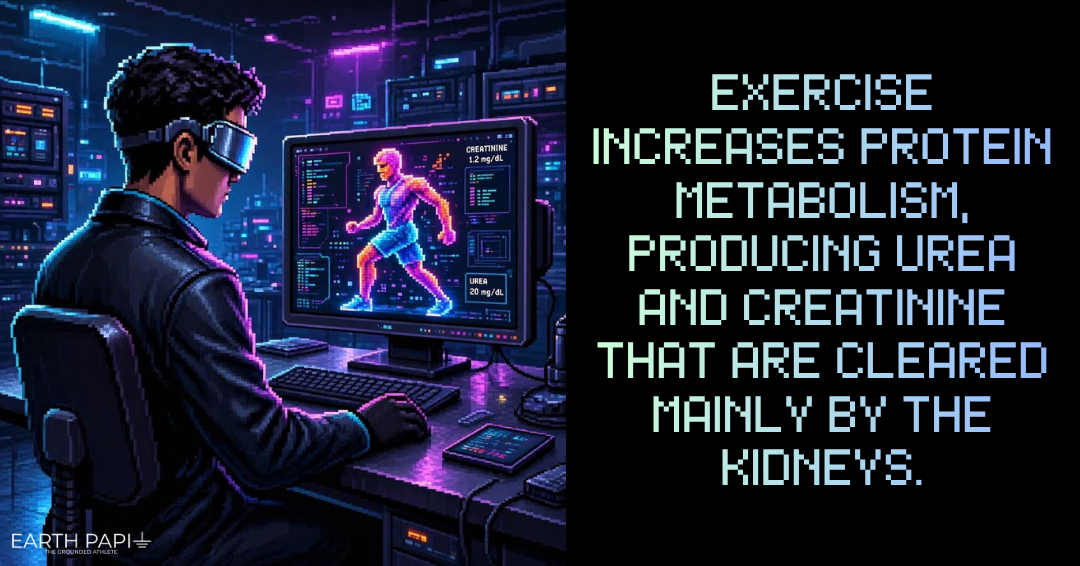
Exercise increases energy demand and can raise amino acid oxidation and protein breakdown. This produces nitrogen waste that is converted into urea by the liver. Creatinine is formed through normal creatine metabolism in muscle. Both substances circulate in the blood and are cleared primarily by the kidneys.
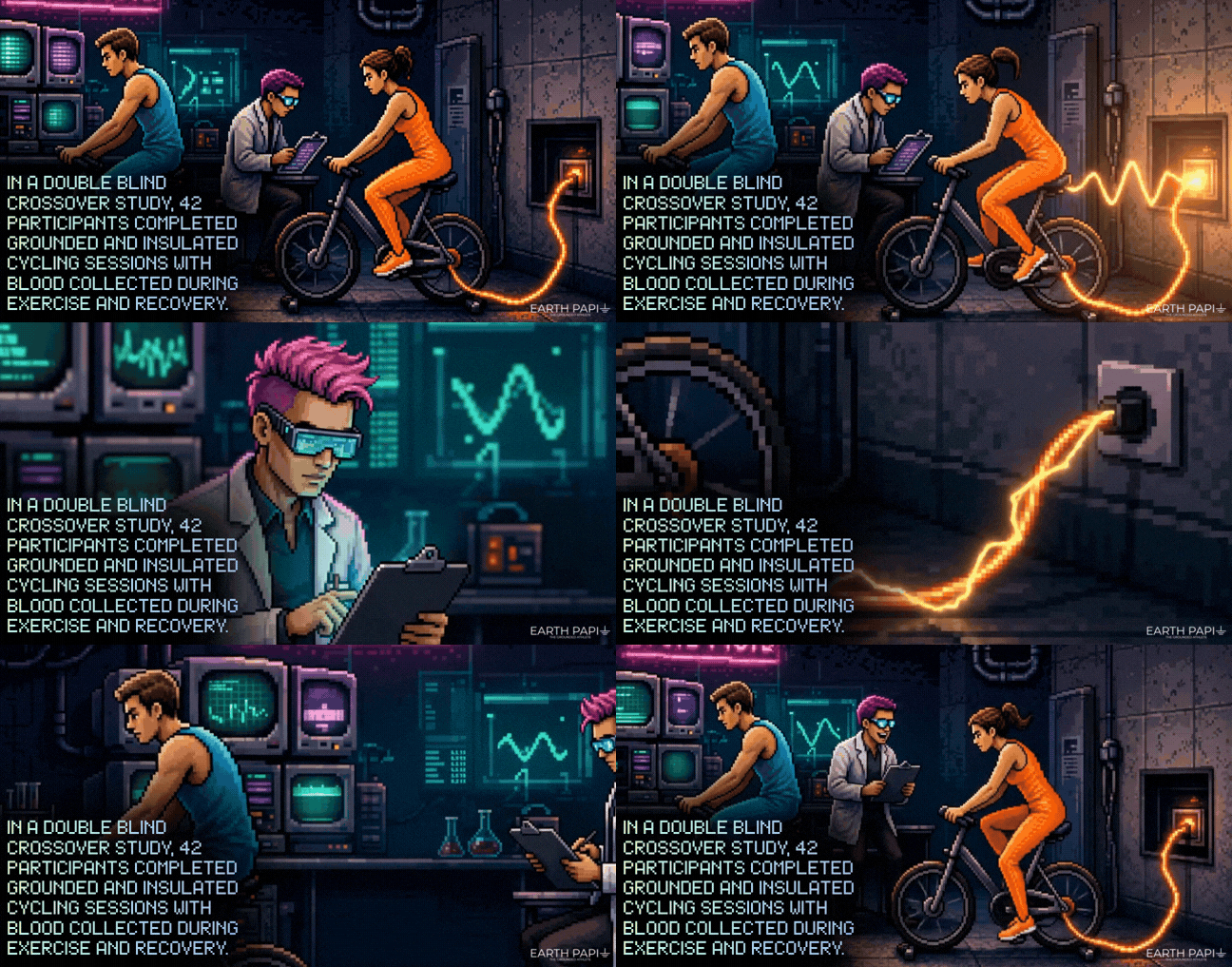
Sokal and colleagues examined whether grounding affected these markers during exercise and recovery. In a double blind crossover study, 42 participants completed two 30 minute cycling sessions. Each participant exercised once while grounded and once while insulated. Blood was collected before exercise, after 15 and 30 minutes of cycling and after 40 minutes of recovery.
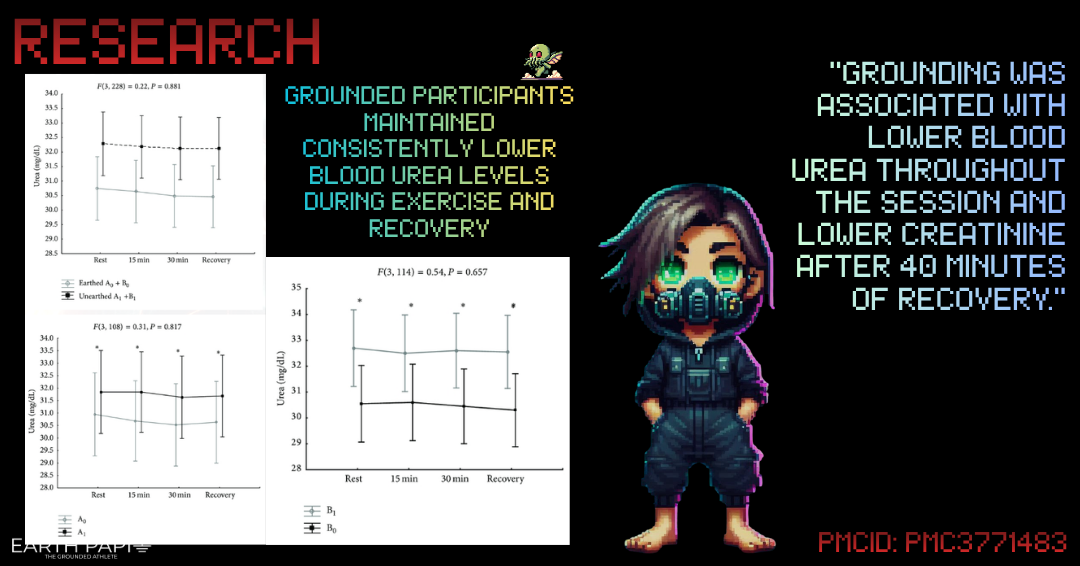
Blood urea was lower during grounded exercise and recovery. Creatinine did not change significantly during exercise but was lower after 40 minutes of grounded recovery.
Lower blood urea could reflect reduced urea production, altered protein metabolism or differences in renal handling. Lower creatinine during recovery could also reflect changes in creatine metabolism or kidney clearance. Since urinary excretion, filtration rate and muscle protein breakdown were not directly measured, the study cannot determine which mechanism produced these changes.
The clearest conclusion is that grounding altered circulating urea and creatinine during exercise and recovery. These findings connect grounding with nitrogen metabolism and the physiological handling of exercise related metabolic waste.
As always, if you’re interested in learning more about grounding, check out Earth & Water :)


References
M. J. Rennie, “Influence of exercise on protein and amino acid metabolism,” in Handbook of Physiology, Section 12 Exercise : Regulation and Integration of Multiple Systems, L. B. Rowel and J. T. Shephard, Eds., pp. 995–1035, Oxford University Press, New York, NY, USA, 1996.
Y. Shimomura, T. Honda, M. Shiraki et al., “Branched-chain amino acid catabolism in exercise and liver disease,” Journal of Nutrition, vol. 136, supplement 1, pp. 250S–253S, 2006.
J. Calles-Escandon, J. J. Cunningham, P. Snyder et al., “Influence of exercise on urea, creatinine, and 3-methylhistidine excretion in normal human subjects,” The American Journal of Physiology, vol. 246, no. 4, pp. E334–E338, 1984.
S. E. Foran, K. B. Lewandrowski, and A. Kratz, “Effects of exercise on laboratory test results,” Laboratory Medicine, vol. 34, no. 10, pp. 736–742, 2003.
Barmore W, Azad F, Stone WL. Physiology, Urea Cycle. [Updated 2022 May 15]. In: StatPearls [Internet]. Treasure Island (FL): StatPearls Publishing; 2022 Jan-. Available from: https://www.ncbi.nlm.nih.gov/books/NBK513323/
A. A. Ferrando, D. Paddon-Jones, and R. R. Wolfe, “Alterations in protein metabolism during space flight and inactivity,” Nutrition, vol. 18, no. 10, pp. 837–841, 2002.
V. Kumar, P. Atherton, K. Smith, and M. J. Rennie, “Human muscle protein synthesis and breakdown during and after exercise,” Journal of Applied Physiology, vol. 106, no. 6, pp. 2026–2039, 2009.
A. C. Guyton and J. E. Hall, “Urine formation by the kidneys,” in Textbook of Medical Physiology, pp. 307–346, Elsevier Saunders, Philadelphia, Pa, USA, 11th edition, 2006.
A. C. Guyton and J. E. Hall, “Protein metabolism,” in Textbook of Medical Physiology, pp. 852–857, Elsevier Saunders, Philadelphia, 11th edition, 2006.
Kashani K, Rosner MH, Ostermann M. Creatinine: From physiology to clinical application. Eur J Intern Med. 2020 Feb;72:9-14. doi: 10.1016/j.ejim.2019.10.025. Epub 2019 Nov 8. PMID: 31708357.
Sokal P, Jastrzębski Z, Jaskulska E, Sokal K, Jastrzębska M, Radzimiński L, Dargiewicz R, Zieliński P. Differences in Blood Urea and Creatinine Concentrations in Earthed and Unearthed Subjects during Cycling Exercise and Recovery. Evid Based Complement Alternat Med. 2013;2013:382643. doi: 10.1155/2013/382643. Epub 2013 Aug 27. PMID: 24066011; PMCID: PMC3771483.
Brown, Richard & Chevalier, Gaetan. (2015). Grounding the Human Body during Yoga Exercise with a Grounded Yoga Mat Reduces Blood Viscosity. Open Journal of Preventive Medicine. 05. 159-168. 10.4236/ojpm.2015.54019.