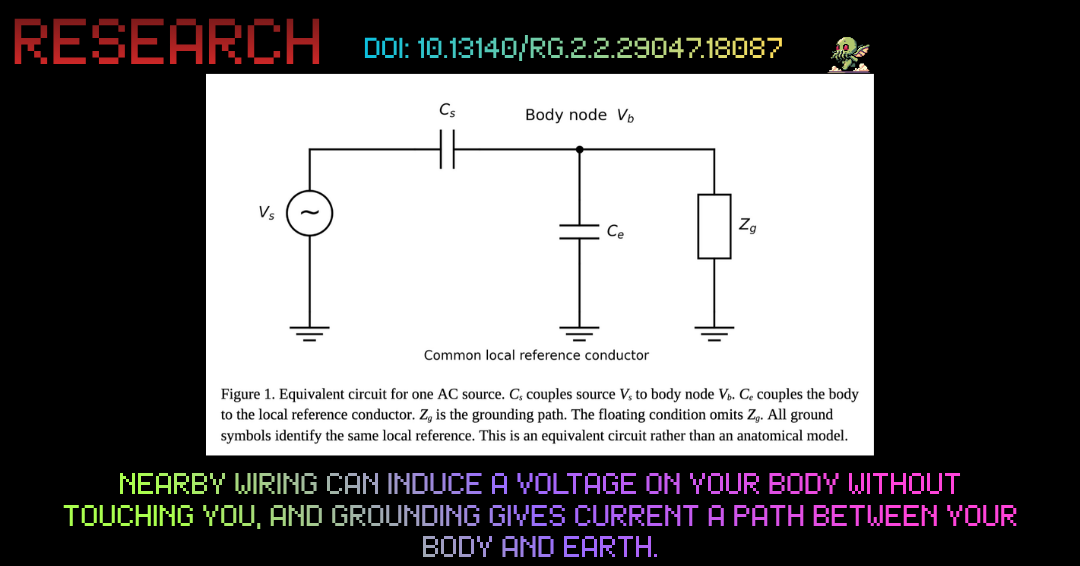
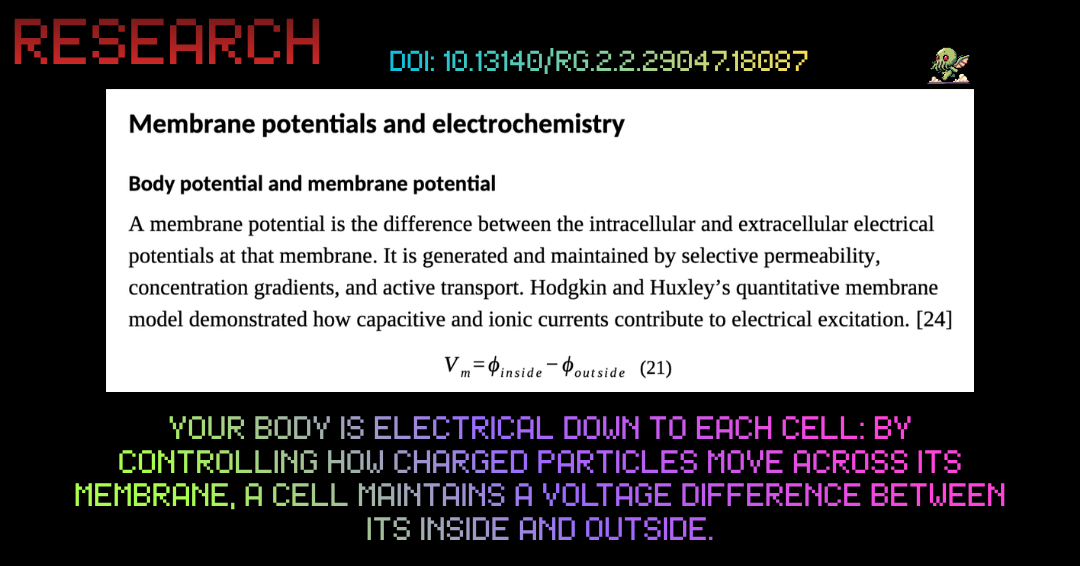
The body continuously interacts with its electrical surroundings. Tissues conduct charge through dissolved ions. Cell membranes maintain voltage differences. Movement and contact with clothing can generate static charge. Nearby wiring can also induce a voltage on the body without direct contact.

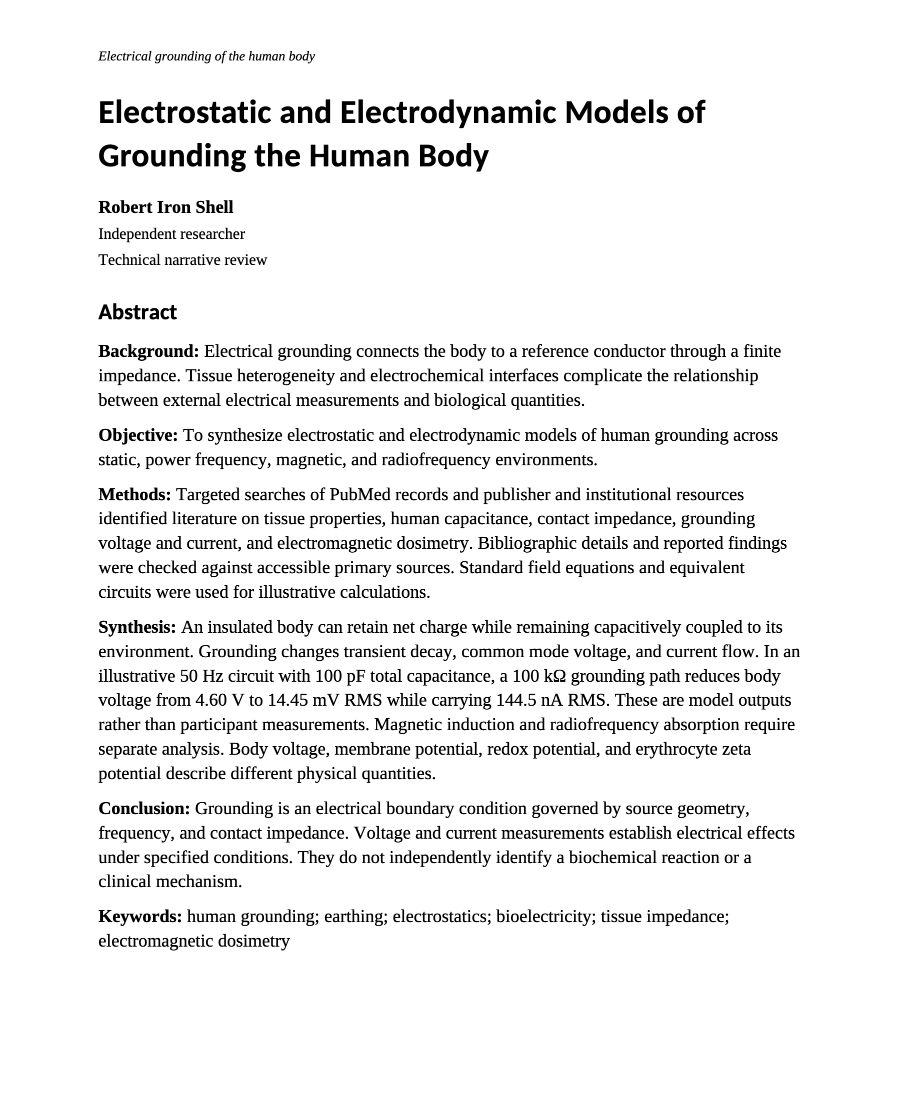
The first article in The Manuscripts Series introduces my review, Electrostatic and Electrodynamic Models of Grounding the Human Body. It examines what changes electrically when a person connects to Earth and how those changes relate to biological measurements.
What changes when we ground?
Insulating footwear and flooring can restrict the movement of charge between the body and Earth. However, electric fields still interact with the body across these insulating materials through capacitive coupling.

Grounding adds a conductive pathway. Accumulated static charge can dissipate and the body’s voltage can move closer to the local Earth reference. The response depends on the surrounding electrical sources and the properties of the connection.
Skin moisture, contact area, footwear, soil and any resistance in the grounding equipment all influence that pathway. Grounding therefore has measurable electrical properties that vary with the conditions.

Lower voltage and continuing current
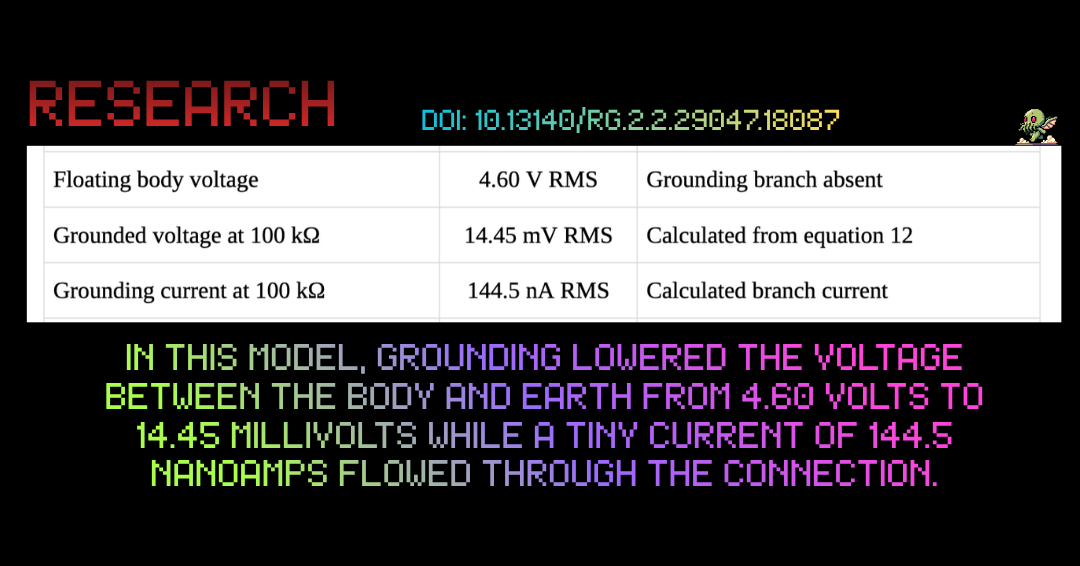
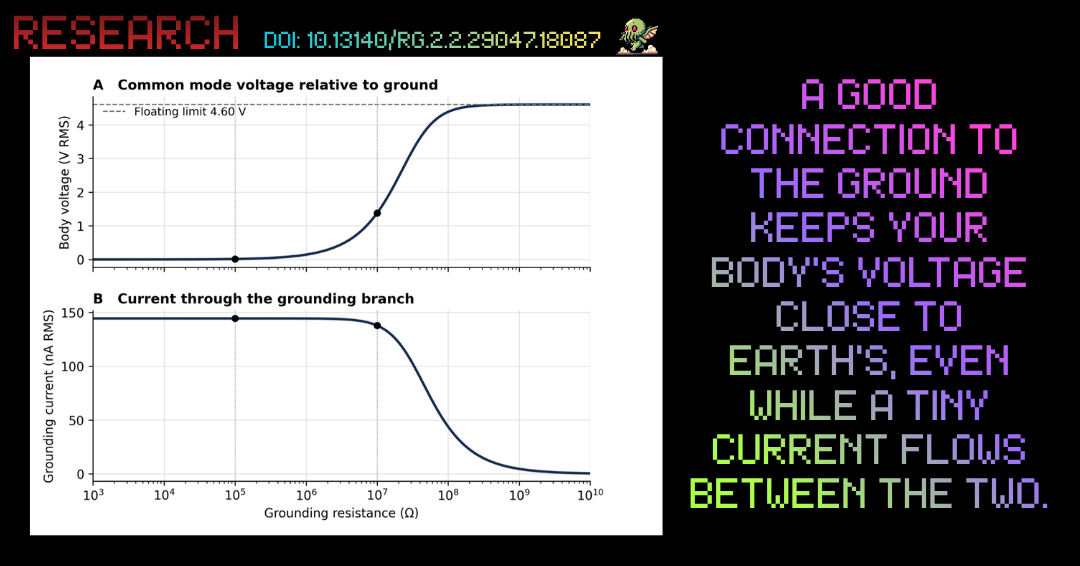
An initial static charge can discharge when the connection is established. If surrounding electrical sources continue to drive the system, a small alternating current can continue through the grounding pathway even while body voltage remains low.
One illustrative calculation in the manuscript models a person exposed to a 50 Hz electrical source. Under the specified assumptions, grounding reduces body voltage from 4.60 volts to 14.45 millivolts, while approximately 144.5 nanoamps flows through the connection.
These are calculated values from an example circuit. They demonstrate how a substantial voltage reduction can occur alongside a small continuing current.

Connecting the physics to biology
The body contains several distinct electrical quantities. A voltage measured between a person and Earth differs from the voltage across a cell membrane. Redox potential describes the tendency of chemical species to exchange electrons. Zeta potential describes an electrical potential near a particle’s surface in a fluid.
Each measurement answers a particular question. A reduction in body voltage establishes an electrical change at the measured terminals. Identifying an effect on cellular energy production or antioxidant chemistry requires measurements of those processes.

The manuscript also considers physiological studies. A trial involving 22 participants found that grounded sleep following downhill running was associated with smaller losses in certain strength and jump measures and a smaller creatine kinase increase. Reported soreness did not differ significantly. These findings describe recovery outcomes under that protocol without identifying the molecular pathway responsible.
The surrounding field matters
Static electric fields, household power frequency fields, changing magnetic fields and radiofrequency signals interact with the body differently. A grounding connection that lowers voltage induced by nearby wiring does not automatically eliminate magnetic induction or radiofrequency absorption.
Understanding the response requires knowing the source, frequency, body position and contact conditions. Voltage and current measurements together provide a more complete electrical description than voltage alone.

The central conclusion
Grounding changes the body’s electrical connection to its environment. It can dissipate accumulated charge, reduce voltage relative to Earth and provide a pathway for externally driven current.
This review provides a physical foundation for interpreting those effects and connecting them carefully to physiological findings. It gives each observation a defined meaning, from charge exchange at the skin to the biological outcomes measured in grounding studies.

Manuscript: Iron Shell, R. Electrostatic and Electrodynamic Models of Grounding the Human Body. Technical narrative review. DOI: 10.13140/RG.2.2.29047.18087