
Earth & Heart: Zeta Potential, Blood Flow, and Grounding

Blood is more than a transport fluid. It is a dynamic connective tissue composed of cells suspended in plasma, constantly responding to mechanical, chemical, and electrical forces. Among its lesser-known properties is zeta potential, the electrical charge that governs how red blood cells (RBCs) interact with each other and with vessel walls.
Red blood cells carry a net negative surface charge, largely due to sialic acid residues on their membranes. This negative charge creates electrostatic repulsion between cells, preventing them from clumping together under healthy conditions. Zeta potential quantifies this repulsion. When zeta potential is high (more negative), blood flows smoothly. When it drops, RBCs aggregate, blood viscosity increases, and resistance to flow rises—placing greater strain on the cardiovascular system.
Elevated blood viscosity is associated with hypertension, thrombosis, endothelial dysfunction, and impaired microcirculation. In small vessels, increased viscosity reduces oxygen and nutrient delivery, while in large vessels it increases friction, inflammation, and plaque formation. For these reasons, zeta potential plays a central role in cardiovascular health.

In a 2013 pilot study, Chevalier, Sinatra, Oschman, and Delaney investigated whether grounding the body could influence red blood cell charge and aggregation. Ten healthy subjects were grounded for two hours via conductive electrodes connected to the Earth. Blood samples taken before and after grounding showed significantly reduced red blood cell clumping and a marked increase in zeta potential.

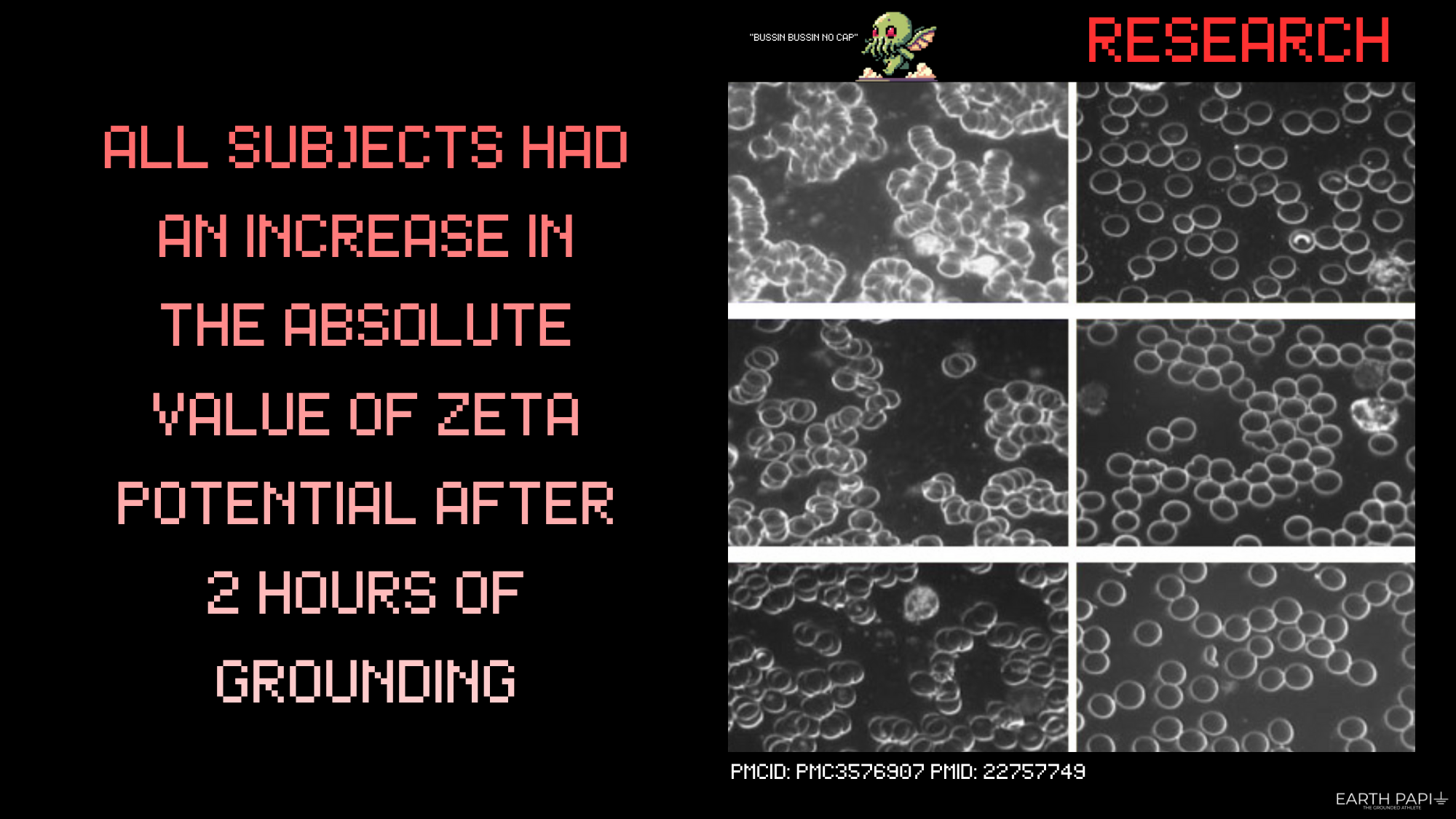
On average, zeta potential increased nearly threefold, moving from suboptimal values into the normal physiological range. Subjects experiencing pain showed the largest improvements, and all participants demonstrated reduced RBC aggregation, indicating a blood-thinning effect without pharmacological intervention.


A follow-up study in 2015 extended these findings by examining blood viscosity during both systolic and diastolic phases of the cardiac cycle while subjects practiced gentle yoga. Participants using grounded mats exhibited significant reductions in blood viscosity, while sham-grounded controls did not. These results suggest that grounding can enhance blood flow dynamics even during mild physical activity.

Together, these studies indicate that grounding improves zeta potential, reduces red blood cell aggregation, and lowers blood viscosity, key factors in cardiovascular function. Unlike anticoagulant drugs, grounding achieves these effects without inhibiting clotting pathways or introducing systemic side effects.
As blood viscosity strongly influences blood pressure and vascular health, improvements in zeta potential may underlie many of grounding’s observed cardiovascular benefits. This sets the stage for deeper exploration of how Earth contact shapes circulation, endothelial function, and heart health.
As always. if you’re interested in learning more about grounding, check out Earth & Water.


Further Reading:
S. Gaikwad, S., G. Avari, J., & Liladhar Patil, M. (2020). Zeta Potential as a Diagnostic Tool to Determine the Angina Risk. Apolipoproteins, Triglycerides and Cholesterol. doi: 10.5772/intechopen.92373
Gaikwad S.S.*, Avari G. J.*, Effect on Morphology, Osmotic Fragility and Electro Kinetic Potential of Erythrocytes in Hypertension, Current Hypertension Reviews 2017; 13(2) . https://dx.doi.org/10.2174/1573402113666170911140747
Riddick, T. M. (1968). Control of Colloid Stability Through Zeta Potential: With a Closing Chapter on Its Relationship to Cardiovascular Disease, Volume 1. Wiley-Interscience.
Baskurt OK, Meiselman HJ. Blood rheology and hemodynamics. Semin Thromb Hemost. 2003 Oct;29(5):435-50. doi: 10.1055/s-2003-44551. PMID: 14631543.
Lowe, G. D. O. (1995). Blood viscosity and cardiovascular disease
Lowe, G. D. (1995). Blood viscosity, lipoproteins, and cardiovascular disease. Arteriosclerosis, thrombosis, and vascular biology, 15(5), 593-602.
Lipowsky, H. H. (2005). Microvascular rheology and hemodynamics. Microcirculation, 12(1), 5-15.
Pries, A. R., Secomb, T. W., & Gaehtgens, P. (1998). The endothelial surface layer. Pflügers Archiv, 440(5), 653-666.
Brun, J.F., Varlet-Marie, E., Romain, A.J., Guiraudou, M. and Raynaud de Mauverger, E. (2013) Exercise Hemorheology: Moving from Old Simplistic Paradigms to a More Complex Picture. Clinical Hemorheology and Microcirculation, 55, 15-27.
Lowe, G., Rumley, A., Norrie, J., Ford, I., Shepherd, J., Cobbe, S., Macfarlane, P. and Packard, C. (2000) Blood Rheology, Cardiovascular Risk Factors, and Cardiovascular Disease: The West of Scotland Coronary Prevention Study. Thrombosis and Haemostasis, 84, 553-558.
Sloczyńska, K., Kózka, M. and Marona, H. (2013) Red Blood Cell Deformability and Aggregation in Chronic Venous Disease Patients with Varicose Veins. Postępy Higieny i Medycyny Doświadczalnej, 67, 690-694. http://www.phmd.pl/fulltxt.php?ICID=1059670 http://dx.doi.org/10.5604/17322693.1059670
Stein, P.D. and Sabbah, H.N. (1974) Measured Turbulence and Its Effect on Thrombus Formation. Circulation Research, 35, 608-614. http://dx.doi.org/10.1161/01.RES.35.4.608
Traub, O. and Berk, B.C. (1998) Laminar Shear Stress: Mechanisms by Which Endothelial Cells Transduce an Atheroprotective Force. Arteriosclerosis, Thrombosis, and Vascular Biology, 18, 677-685. http://dx.doi.org/10.1161/01.ATV.18.5.677
Chevalier G, Sinatra ST, Oschman JL, Delany RM. Earthing (grounding) the human body reduces blood viscosity-a major factor in cardiovascular disease. J Altern Complement Med. 2013 Feb;19(2):102-10. doi: 10.1089/acm.2011.0820. Epub 2012 Jul 3. PMID: 22757749; PMCID: PMC3576907.
El-Sayed MS. Effects of exercise and training on blood rheology. Sports Med. 1998 Nov;26(5):281-92. doi: 10.2165/00007256-199826050-00001. PMID: 9858393.
Connes P, Pichon A, Hardy-Dessources MD, Waltz X, Lamarre Y, Simmonds MJ, Tripette J. Blood viscosity and hemodynamics during exercise. Clin Hemorheol Microcirc. 2012;51(2):101-9. doi: 10.3233/CH-2011-1515. PMID: 22240371.
Hitosugi M, Kawato H, Nagai T, Ogawa Y, Niwa M, Iida N, Yufu T, Tokudome S. Changes in blood viscosity with heavy and light exercise. Med Sci Law. 2004 Jul;44(3):197-200. doi: 10.1258/rsmmsl.44.3.197. PMID: 15296241.
Brown, R., & Chevalier, G. (2015). Grounding the Human Body during Yoga Exercise with a Grounded Yoga Mat Reduces Blood Viscosity. Open Journal of Preventive Medicine, 05, 159-168.