
Earth & HRV: Grounding, the Autonomic Nervous System, and Vagal Tone

Heart rate variability (HRV) refers to the variation in time between successive heartbeats. Rather than indicating irregularity, higher HRV reflects a healthy and adaptable autonomic nervous system (ANS), particularly strong parasympathetic or vagal activity. HRV is widely used as a marker of stress resilience, cardiovascular health, and recovery capacity.

Previous work discussed in Earth & Mind showed that grounding premature infants in a neonatal intensive care setting produced immediate improvements in autonomic regulation. Grounded infants displayed increased HRV, indicating enhanced vagal tone and improved regulation of stress and inflammatory responses. This finding raised a broader question: could grounding produce similar autonomic effects in healthy adults?

To explore this, a 2011 study by Chevalier and Sinatra examined the effects of grounding on HRV in 24 healthy adults. Participants served as their own controls and underwent two-hour sessions consisting of alternating periods of insulated, grounded, and sham-grounded conditions. Grounding was achieved using conductive electrodes connected to an outdoor grounding rod, with ECG data continuously recorded.

HRV was analyzed using standard time-domain and frequency-domain measures, including SDNN (the standard deviation of beat-to-beat intervals), high-frequency (HF), low-frequency (LF), and very-low-frequency (VLF) components, along with the LF/HF ratio. These metrics are commonly used to assess autonomic balance, with HF primarily reflecting parasympathetic activity and vagal tone.
The results were consistent and striking. Grounded subjects showed significantly greater increases in HRV compared to non-grounded controls. HF power increased by approximately 63% during grounding, nearly double the increase observed in the insulated condition. LF power and SDNN showed similar patterns, with the grounded group exhibiting more than double the improvement seen in controls. Importantly, the LF/HF ratio remained stable, indicating that the increases in LF were driven by parasympathetic activation rather than sympathetic stress.

Taken together, these findings suggest that grounding produces a measurable shift toward parasympathetic dominance that exceeds simple relaxation. The autonomic response observed during grounding was sustained throughout the grounded period and reversed upon disconnection, indicating a direct physiological effect rather than a placebo or habituation response.
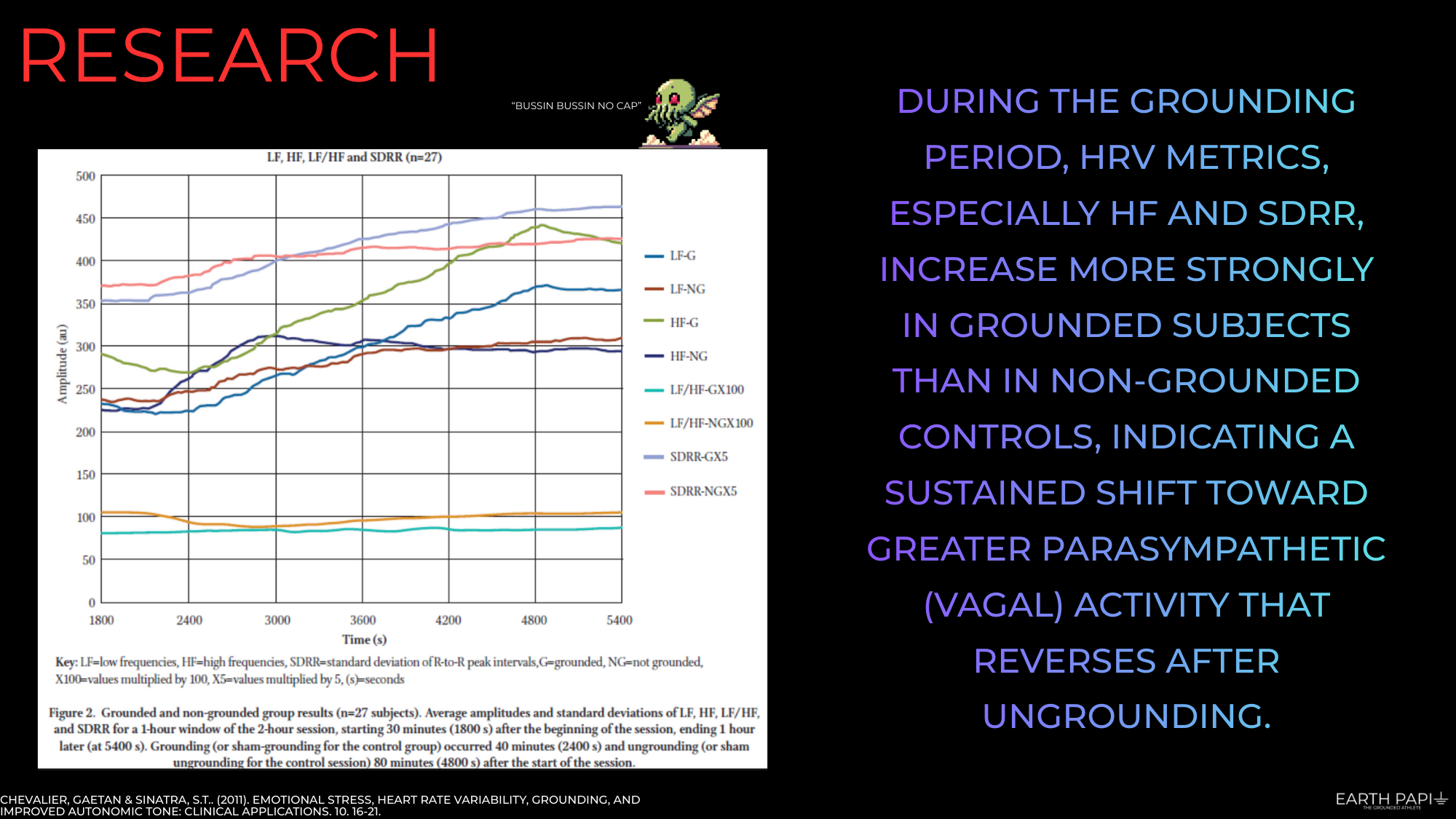
When viewed alongside HRV data from meditation studies discussed earlier, grounding appears to produce autonomic changes comparable to, and in some cases exceeding, those seen during deep meditative states. This convergence strengthens the interpretation that grounding supports vagal tone, autonomic balance, and systemic recovery.

HRV is not only a marker of nervous system health but also a predictor of cardiovascular risk and mortality. Improving HRV is therefore a clinically relevant target. Grounding represents a low-cost, accessible environmental input that may support autonomic regulation and cardiovascular resilience by reconnecting the body electrically to the Earth.
As always, if you’re interested in learning more about this, check out Earth & Water.
Study:
Chevalier, Gaetan & Sinatra, S.T.. (2011). Emotional stress, heart rate variability, grounding, and improved autonomic tone: clinical applications. 10. 16-21.