

In 2023, Park and colleagues investigated whether grounding could influence stress-related behavior and neuroendocrine signaling in rats. The study focused on anxiety-like and depressive-like behaviors, along with molecular markers associated with activation of the hypothalamic–pituitary–adrenal (HPA) axis.
Male Sprague–Dawley rats were divided into four groups: a normal group, a control group, and two grounding groups. One grounding group was exposed to grounding mats for the final 7 days of the experiment, while the other was grounded for 21 consecutive days. Behavioral testing was conducted on day 22.
To assess behavioral outcomes, the researchers used three well-established paradigms. The elevated plus maze (EPM) was used to evaluate anxiety-like behavior and exploratory activity. The tail suspension test (TST) and forced swimming test (FST) were used to assess depression-like behavior and behavioral despair. These tests are widely used in stress and affective neuroscience and are sensitive to manipulations of the HPA axis.
In parallel with behavioral testing, the authors examined neuronal activation within the paraventricular nucleus (PVN) of the hypothalamus. Specifically, they measured expression of c-Fos, a marker of neuronal activity, and corticotropin-releasing factor (CRF), a neuropeptide that initiates the HPA axis stress response. Increased expression of c-Fos and CRF in the PVN is a hallmark of stress-induced hypothalamic activation and glucocorticoid signaling.
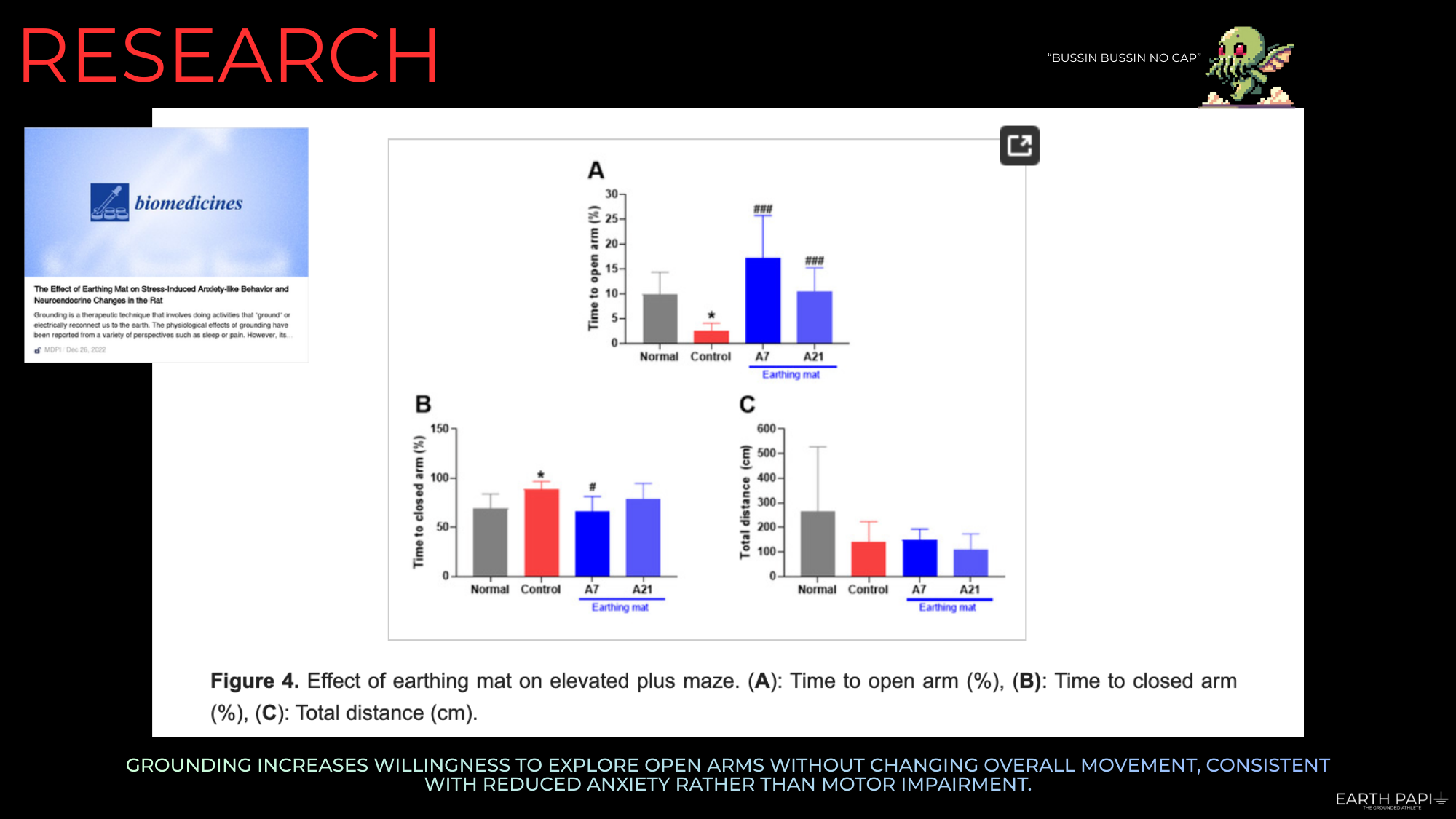
The results showed that grounded rats spent significantly more time in the open arms of the elevated plus maze compared to controls. This behavioral shift is interpreted as reduced anxiety-like behavior. At the neuroendocrine level, grounded rats exhibited a significant reduction in CRF-immunoreactive neurons in the PVN relative to controls. There was also a trend toward reduced c-Fos expression in grounded animals, although this reduction did not reach statistical significance.

Taken together, these findings suggest that grounding may attenuate stress-related behavior while dampening activation of corticotrophinergic pathways within the hypothalamus. The authors conclude that grounding mats may influence stress regulation through modulation of HPA-axis-related neural mechanisms.
As with all rodent studies, direct translation to humans requires caution. Nonetheless, the convergence of behavioral and neurobiological measures makes the results mechanistically interesting and relevant for further investigation into grounding and stress physiology.
As always, if you’re interested in learning more about this, check out Earth & Water.
Further Reading:
Angeles-Castellanos M, Aguilar-Roblero R, Escobar C. c-Fos expression in hypothalamic nuclei of food-entrained rats. Am J Physiol Regul Integr Comp Physiol. 2004 Jan;286(1):R158-65. doi: 10.1152/ajpregu.00216.2003. Epub 2003 Aug 21. PMID: 12933360.
Senba E, Matsunaga K, Tohyama M, Noguchi K. Stress-induced c-fos expression in the rat brain: activation mechanism of sympathetic pathway. Brain Res Bull. 1993;31(3-4):329-44. doi: 10.1016/0361-9230(93)90225-z. PMID: 8490732.
Jeffrey, J.D.; Gollock, M.J.; Gilmour, K.M. Social stress modulates the cortisol response to an acute stressor in rainbow trout (Oncorhynchus mykiss). Gen. Comp. Endocrinol. 2014, 196, 8–16.
Arikawe, A.P.; Rorato, R.C.; Gomes, N.; Elias, L.L.; Anselmo-Franci, J. Hormonal and neural responses to restraint stress in an animal model of perimenopause in female rats. J. Neuroendocrinol. 2021, 33, e12976.
De Oliveira, R.P.; de Andrade, J.S.; Spina, M.; Chamon, J.V.; Silva, P.H.D.; Werder, A.K.; Ortolani, D.; Thomaz, L.D.S.C.; Romariz, S.; Ribeiro, D.A.; et al. Clozapine prevented social interaction deficits and reduced c-Fos immunoreactivity expression in several brain areas of rats exposed to acute restraint stress. PLoS ONE 2022, 17, e0262728.
Fóscolo, D.R.C.; Lima, P.M.A.; Rodovalho, G.V.; Coimbra, C.C. Early maternal separation alters the activation of stress-responsive brain areas in adulthood. Neurosci. Lett. 2022, 771, 136464.
Koureta, M.; Karaglani, M.; Panagopoulou, M.; Balgkouranidou, I.; Papadaki-Anastasopoulou, A.; Zarouchlioti, C.; Dekavallas, S.; Kolios, G.; Lambropoulou, M.; Baritaki, S.; et al. Corticotropin Releasing Factor Receptors in breast cancer: Expression and activity in hormone-dependent growth in vitro. Peptides 2020, 129, 170316.
Wang, Y.; Li, G.; Wang, X.; Zhu, S. Effects of Shugan Hewei Granule on Depressive Behavior and Protein Expression Related to Visceral Sensitivity in a Rat Model of Nonerosive Reflux Disease. Evid. Based Complement Alternat. Med. 2019, 2019, 1505693.
Wu, W.Y.; Liu, Y.; Wu, M.C.; Wang, H.W.; Chu, C.P.; Jin, H.; Li, Y.Z.; Qiu, D.L. Corticotrophin-Releasing Factor Modulates the Facial Stimulation-Evoked Molecular Layer Interneuron-Purkinje Cell Synaptic Transmission in vivo in Mice. Front. Cell Neurosci. 2020, 14, 563428.
Park H-J, Jeong W, Yu HJ, Ye M, Hong Y, Kim M, Kim JY, Shim I. The Effect of Earthing Mat on Stress-Induced Anxiety-like Behavior and Neuroendocrine Changes in the Rat. Biomedicines. 2023; 11(1):57. https://doi.org/10.3390/biomedicines11010057