
Grounding and Calcium Phosphate Homeostasis

Calcium and phosphate are not simply materials stored in bone. Calcium supports muscle contraction, nerve transmission and cell signaling. Phosphate forms part of ATP, cell membranes and the body’s buffering system. Their concentrations are continuously regulated through exchange between the blood, cells, kidneys, intestines and skeleton.
Karol and Paweł Sokal examined whether grounding could influence this mineral balance. Their double blind experiment included 84 adults between the ages of 20 and 64. Participants were grounded overnight through a copper plate attached to the leg and connected to moist Earth. Blood and urine were collected before and after the intervention.

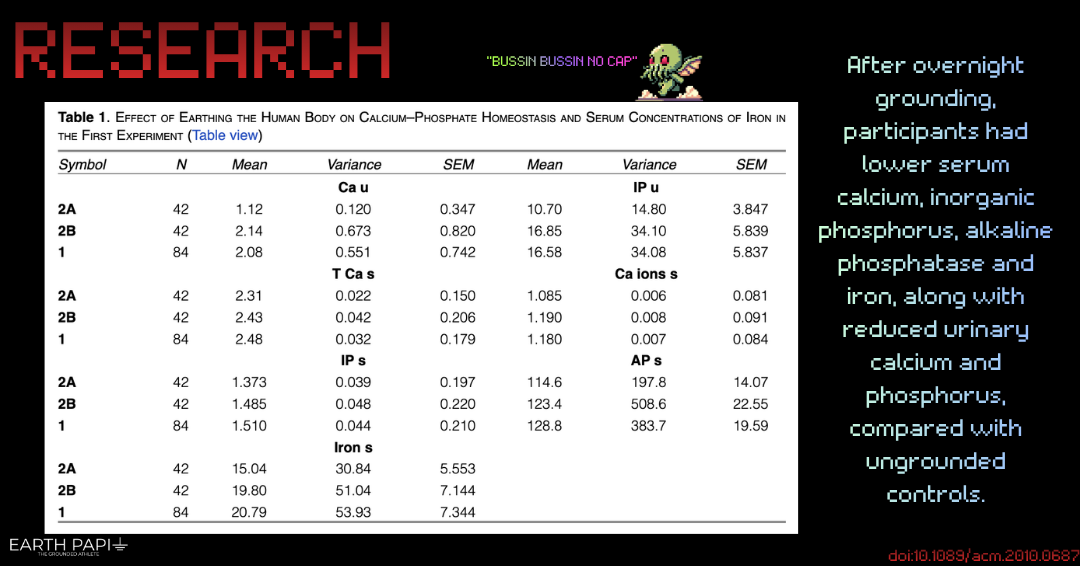
After eight hours, the grounded group showed lower serum concentrations of ionized calcium, total calcium, inorganic phosphorus, iron and alkaline phosphatase. Grounding also reduced the amount of calcium and phosphorus excreted through the kidneys.
A related experiment involving 28 participants found additional changes in sodium, potassium, magnesium, chloride, calcium and phosphate concentrations. Some shifts appeared after only one hour of grounding. Interrupting the Earth connection also altered several values, indicating that mineral distribution responded to the presence or absence of electrical contact.
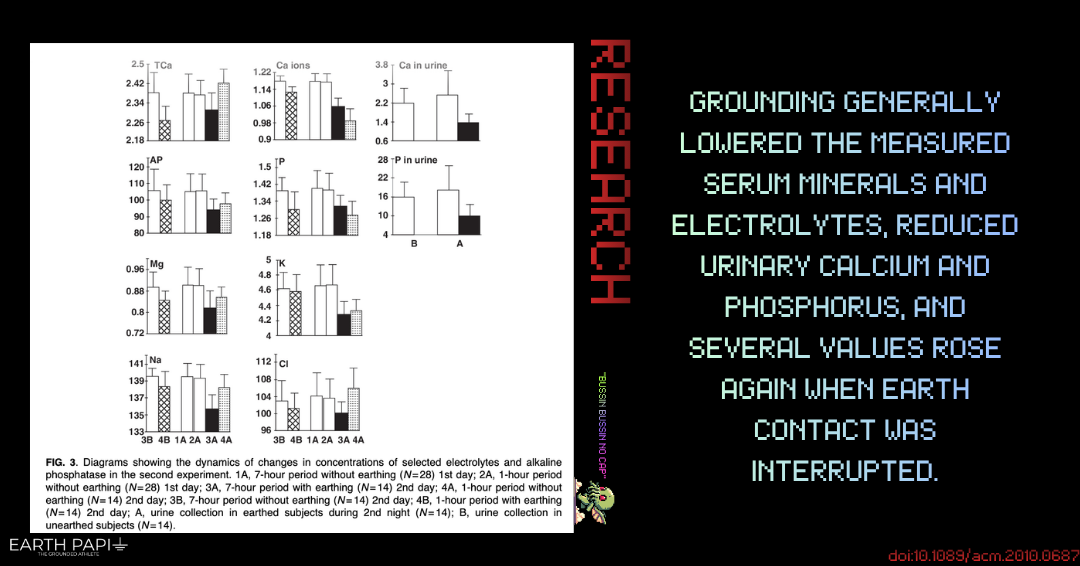
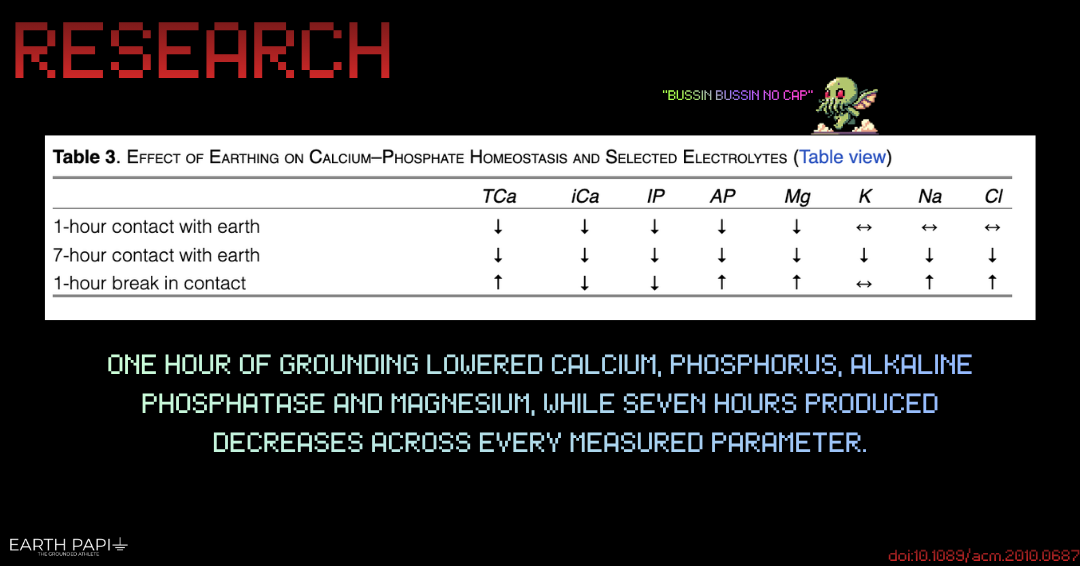
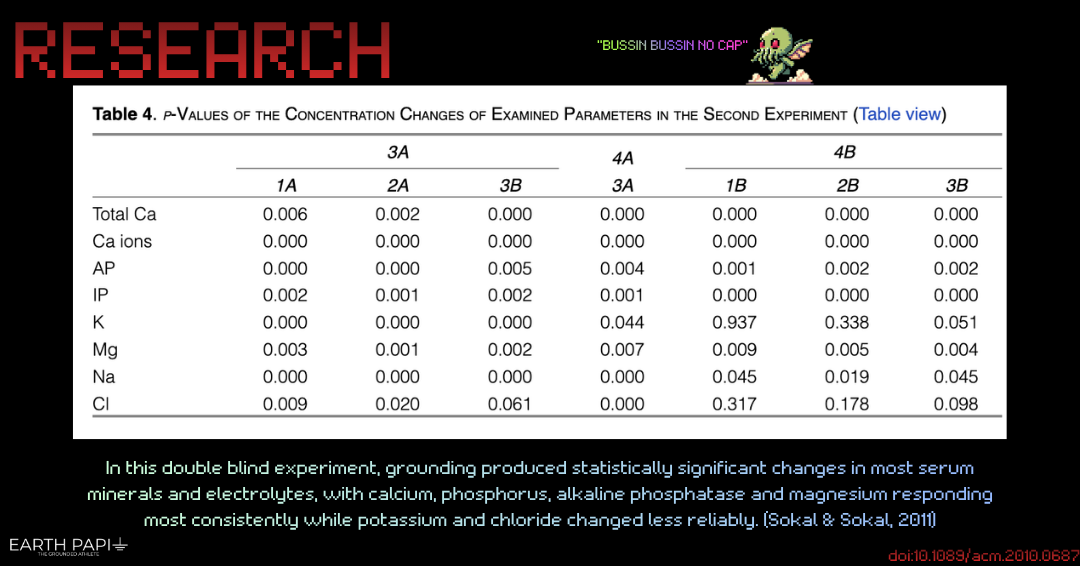
Lower blood concentrations do not necessarily mean the body lost these minerals. Blood levels reflect several simultaneous processes including renal filtration, cellular uptake, intestinal absorption and skeletal exchange. The reduction in urinary calcium and phosphorus suggests greater retention, while the researchers proposed that some minerals may have shifted toward skeletal storage. However, the study did not directly measure bone mineral density, bone deposition or osteoblast activity.

The strongest conclusion is that grounding produced measurable changes in calcium phosphate homeostasis and electrolyte regulation. These systems are central to bone remodeling, cellular signaling and energy metabolism. The findings therefore connect grounding with the physiology surrounding bone health, without treating the experiment itself as a clinical osteoporosis trial.


Reference
Sokal, K., & Sokal, P. (2011). Earthing the human body influences physiologic processes. Journal of Alternative and Complementary Medicine, 17(4), 301–308. https://doi.org/10.1089/acm.2010.0687
Mayer G. Parathyroid hormone secretion. In: De Groot L. Endocrinology, Part II. New York: Grune and Stratton, 1979.
Steimetz T, Mandalunis PM, Ubios AM. Effect of compressive forces on a bone modelling surface. Acta Odontol Latinoam. 1997;10(2):111-5. PMID: 11885237.
Bullock J, Boyle J, Wang MB. Physiology, 2nd ed. The National Medical Series for Independent Study. Philadelphia, Baltimore, Hong Kong, London, Munich, Sydney & Tokyo: Harwal Publishing, 1991.
Yu E, Sharma S. Physiology, Calcium. [Updated 2022 Aug 22]. In: StatPearls [Internet]. Treasure Island (FL): StatPearls Publishing; 2023 Jan-. Available from: https://www.ncbi.nlm.nih.gov/books/NBK482128/
Mayer G. Parathyroid hormone secretion. In: De Groot L. Endocrinology, Part II. New York: Grune and Stratton, 1979.
Khan M, Jose A, Sharma S. Physiology, Parathyroid Hormone. 2022 Oct 29. In: StatPearls [Internet]. Treasure Island (FL): StatPearls Publishing; 2023 Jan–. PMID: 29763115.
https://health.gov/healthypeople/about/workgroups/osteoporosis-workgroup
Martínez de Victoria E. El calcio, esencial para la salud [Calcium, essential for health]. Nutr Hosp. 2016 Jul 12;33(Suppl 4):341. Spanish. doi: 10.20960/nh.341. PMID: 27571860.
Institute of Medicine (US) Committee to Review Dietary Reference Intakes for Vitamin D and Calcium; Ross AC, Taylor CL, Yaktine AL, et al., editors. Dietary Reference Intakes for Calcium and Vitamin D. Washington (DC): National Academies Press (US); 2011. 2, Overview of Calcium. Available from: https://www.ncbi.nlm.nih.gov/books/NBK56060/
Weaver CM, Peacock M. Calcium. Adv Nutr. 2019 May 1;10(3):546-548. doi: 10.1093/advances/nmy086. PMID: 30915443; PMCID: PMC6520034.
Qadeer HA, Bashir K. Physiology, Phosphate. 2022 Aug 29. In: StatPearls [Internet]. Treasure Island (FL): StatPearls Publishing; 2023 Jan–. PMID: 32809760.
Peacock M. Phosphate Metabolism in Health and Disease. Calcif Tissue Int. 2021 Jan;108(1):3-15. doi: 10.1007/s00223-020-00686-3. Epub 2020 Apr 7. PMID: 32266417.
Goretti Penido M, Alon US. Phosphate homeostasis and its role in bone health. Pediatr Nephrol. 2012 Nov;27(11):2039-2048. doi: 10.1007/s00467-012-2175-z. Epub 2012 May 3. Erratum in: Pediatr Nephrol. 2017 Jul 6;: PMID: 22552885; PMCID: PMC3461213.
Takeda E, Taketani Y, Sawada N, Sato T, Yamamoto H. The regulation and function of phosphate in the human body. Biofactors. 2004;21(1-4):345-55. doi: 10.1002/biof.552210167. PMID: 15630224.