
How Grounding Makes You More Attractive (Earth & The Beauty Effect)

Skin appearance tracks underlying physiology and circulation sets the boundary conditions: nutrient delivery, oxygen flux, waste removal, and redox balance. When flow becomes irregular or reduced, gradients steepen, local stress rises, and the visible markers of aging follow.

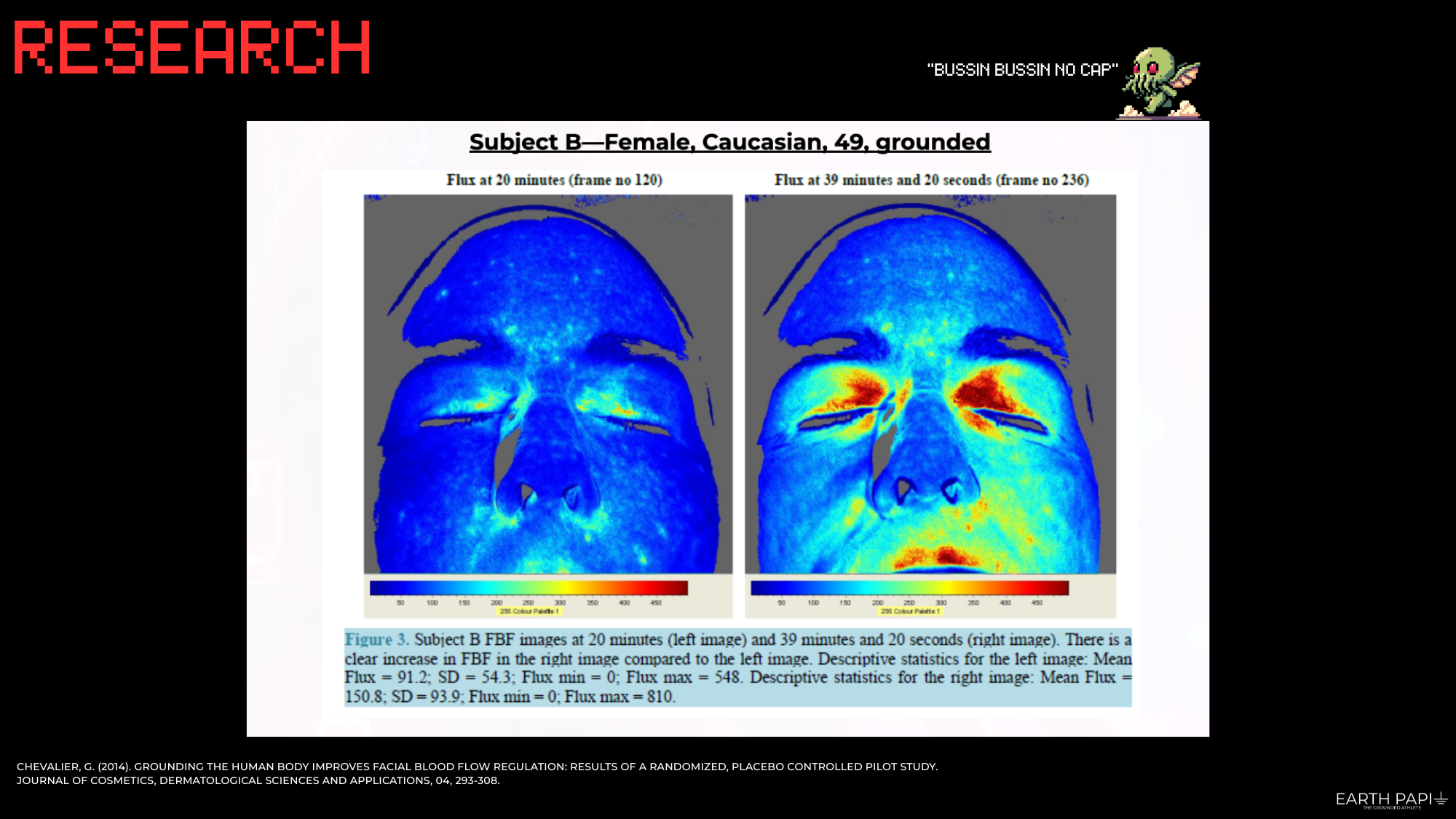
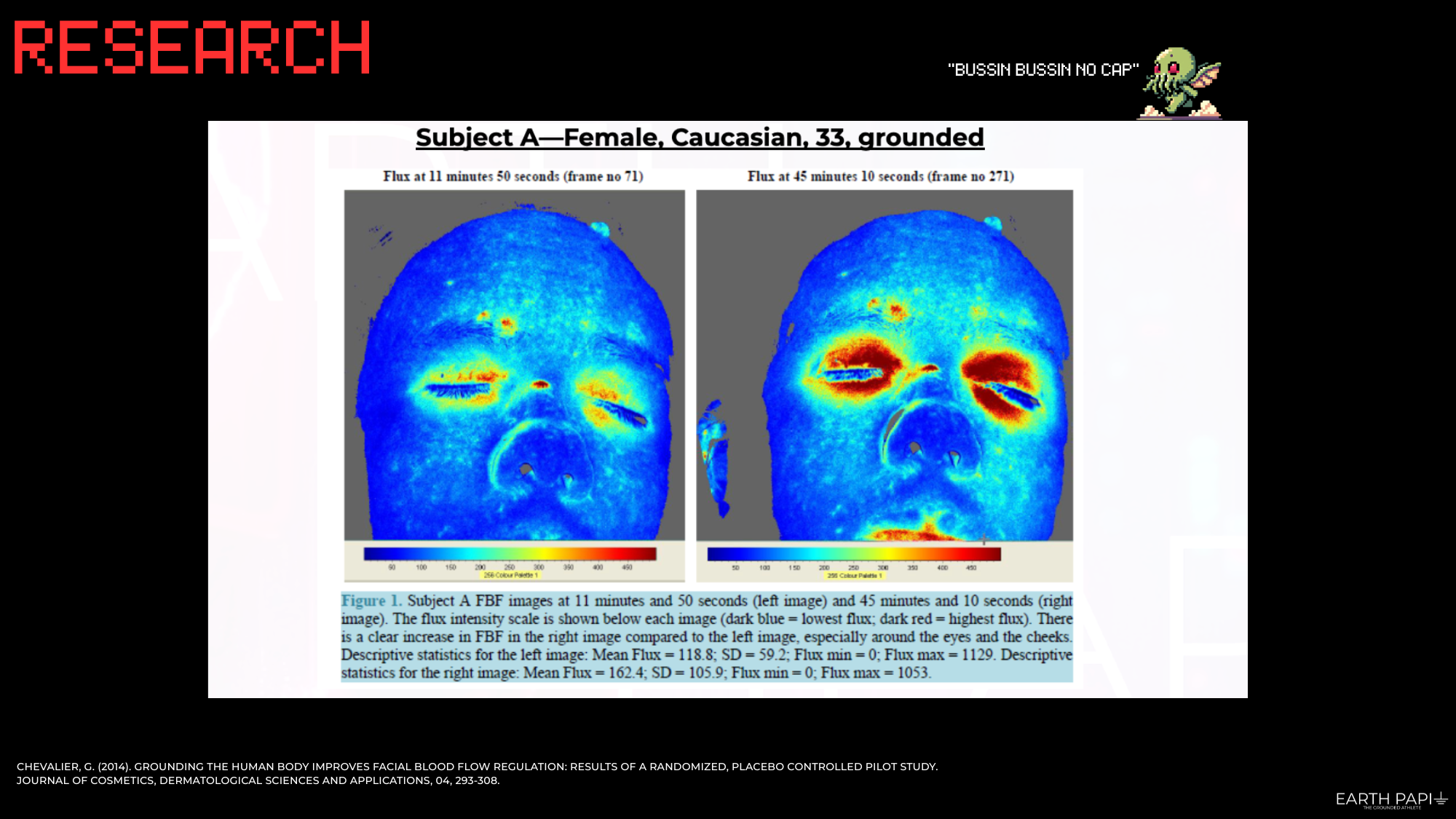
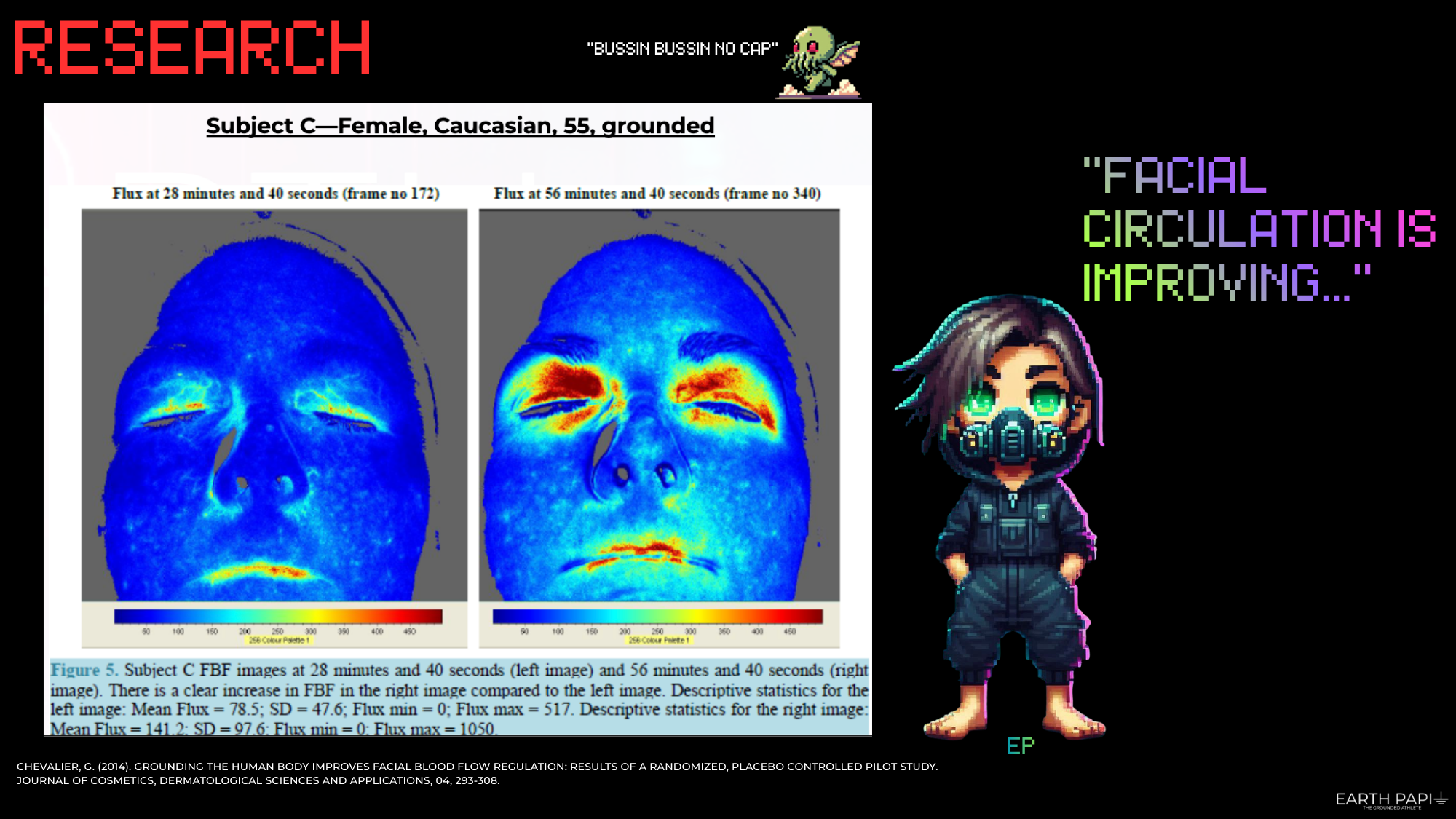
Gaétan Chevalier and colleagues examined whether grounding alters this system at the level of facial microcirculation. In their work, subjects were either grounded or sham grounded while blood flow was measured using Laser Speckle Contrast Imaging (LSCI). This technique resolves relative changes in perfusion in real time by analyzing interference patterns produced by coherent light interacting with moving red blood cells. The output is a spatial map of flow intensity and distribution, not just a static temperature proxy.
The protocol compared multiple participants across age groups and conditions. Grounded subjects showed a rapid shift in facial perfusion patterns, while control subjects did not exhibit comparable changes. The effect was not a simple global increase. Instead, flow became more organized. Regions that were previously underperfused increased, while areas of irregular or excessive signal stabilized. The most consistent changes appeared in the periorbital region and across the mid face, where microvascular density is high and autonomic control is prominent .

This points to regulation rather than stimulation. The autonomic nervous system controls vasodilation and vasoconstriction through sympathetic and parasympathetic signaling. When that control improves, spatial variance in blood flow decreases. In physical terms, Δflow across neighboring regions reduces, producing a more uniform distribution. That is the signature seen in the grounded condition.
Thermography studies conducted alongside this work support the same interpretation. Infrared imaging showed shifts from localized hot regions toward more even temperature fields after grounding exposure. Because surface temperature reflects underlying perfusion and inflammatory activity, this aligns with the LSCI findings: less localized stress and more coherent flow.
The link to appearance follows directly. Collagen synthesis, elastin maintenance, and cellular turnover depend on sustained delivery of substrates and efficient removal of byproducts. Poor circulation introduces delays and gradients that favor breakdown over repair. Over time, this expresses as reduced elasticity, uneven tone, and structural degradation.

Grounding appears to shift the system toward a lower variance state. Blood flow becomes more evenly distributed. Autonomic control improves. In that environment tissue maintenance processes operate with fewer constraints. The observed beauty effect is not cosmetic in origin. It is a macroscopic consequence of improved microvascular regulation.
This stands in contrast to most cosmetic interventions. Many techniques increase circulation through controlled damage or external stimulation. They force a response. Grounding, based on these observations, alters the baseline state of regulation without mechanical or chemical perturbation. The change emerges from system level dynamics rather than local injury.
The implication is narrow but clear. If facial appearance depends on microcirculatory stability, then interventions that improve vascular regulation will express visually. The study does not claim reversal of aging. It shows that even short duration exposure can shift blood flow patterns toward a more organized state. In a system where structure depends on flow, that shift is not trivial.
That’s it for our Earth & Heart Series. If you’re interested in learning more, check out Earth & Water.
Up next, Earth & Death..

References:
Madvin, J., & Khalid, M. (2021). How Localized Grounding, Combined with Conductive Skincare, Improves the Outcomes of the Traditional Skincare? European Journal of Medical and Health Sciences.
Chevalier, G. (2014). Grounding the Human Body Improves Facial Blood Flow Regulation: Results of a Randomized, Placebo Controlled Pilot Study. Journal of Cosmetics, Dermatological Sciences and Applications, 04, 293-308.